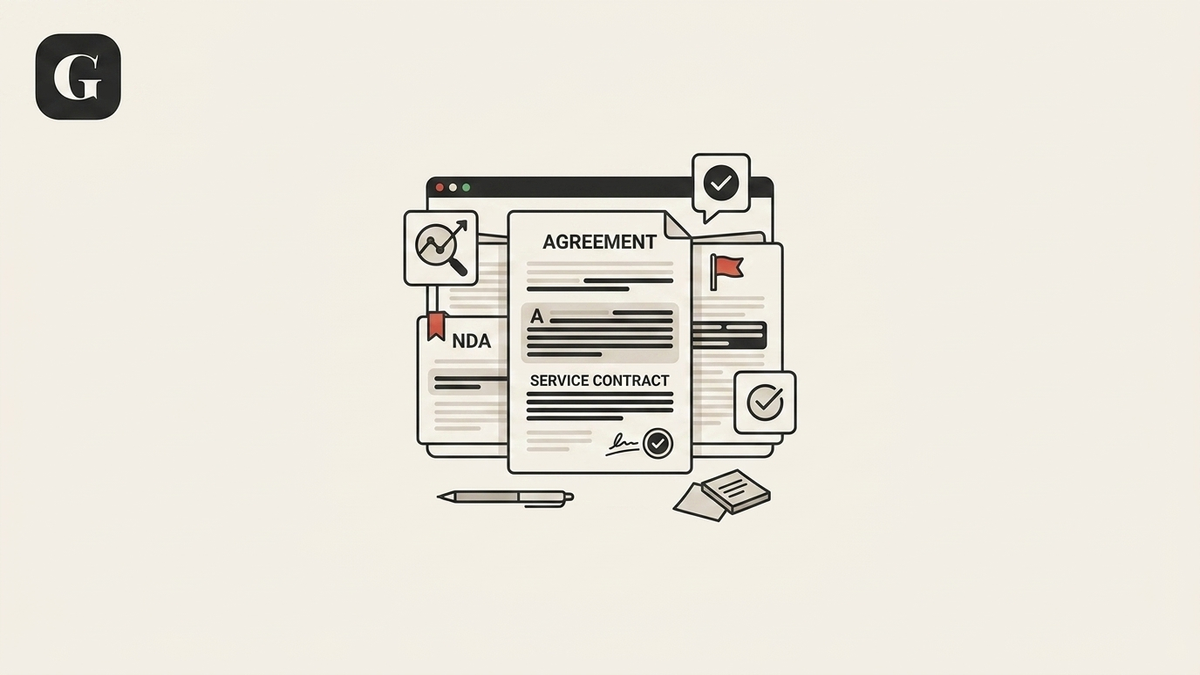
How to Check a Lease, NDA, or Service Agreement Fast A slow legal review is expensive, and a sloppy one is worse. Deloitte and DocuSign's 2024 research estimated that poor agreement management costs the global economy about $2 trillion a year, with another 55 billion hours lost to disconnected workflows. If you need to check lease before signing, or you are facing an NDA review or service agreement review, the real problem is not speed. It is missing the one clause that shifts money, liability, or exit rights.
Start with the contract type, then read the risk points
A lease, NDA, and service agreement do not fail in the same way. A lease usually turns on rent, renewal, maintenance, deposit, and termination. An NDA turns on confidentiality scope, permitted disclosures, term, and remedies. A service agreement turns on scope, deliverables, payment triggers, acceptance, warranty, and liability. A contract scanner UAE workflow is useful because it separates document type before it starts flagging clauses, which is the only sane way to triage a pile of legal text. That order matters because reading linearly is a trap. The first pages often look harmless, but the actual risk sits in the definitions, the schedules, and the boilerplate that changes the meaning of the main terms. In practice, a legal document review should begin with a fast pass for the clauses that move money or lock you in.
When you check lease before signing, look for five clauses first
For tenants in the UAE, the lease is not just about monthly rent. It is about what happens when the landlord raises the rent, keeps the deposit, delays repairs, or ends the term early. Rent escalation clause - Check whether the landlord can increase rent automatically, and whether the lease ties that increase to a formula or a notice period. Maintenance and repairs - The lease should say who handles AC, plumbing, structural defects, and emergency repairs. Vague wording usually favors the party who drafted the lease. Deposit return - Look for the exact timeline, deductions that are allowed, and whether the deposit can be used against unpaid utilities or damage. Renewal and termination - A lease can look stable until you see a short termination notice, a non-renewal window, or a penalty for early exit. Jurisdiction and governing law - In the UAE, this is not decorative language. It tells you which forum may hear a dispute and whether the document is aligned with local rules. This is where plain language beats legal jargon. 'Automatic renewal unless notice is given' means you may be locked in if you miss the deadline. 'At landlord's discretion' usually means the landlord keeps the leverage. If the lease hides those phrases in dense wording, you need a clause-by-clause pass, not a skim.
NDA review is mostly about scope, not secrecy
Most people read an NDA as if the only question is, 'Can I disclose this?' That is too narrow. The real question is, 'What exactly counts as confidential, who can receive it, and how long does the restriction last?' A strong NDA review should test four things. First, the definition of confidential information should be specific enough that ordinary business talk is not swept in by accident. Second, the list of permitted disclosures should cover lawyers, accountants, affiliates, and employees who need access. Third, the term should not outlive the business reality by years without reason. Fourth, the remedies should be proportionate. If the agreement threatens extreme relief for a minor breach, the clause is built to scare, not to govern. Gartner's 2024 forecast that 50% of organizations will use AI-enabled contract negotiation tools by 2027 is telling, not because AI replaces judgment, but because teams are drowning in repetition. An NDA review is repetitive when it should be precise. A good review does not ask whether the document is confidential enough in the abstract. It asks which disclosures are barred, which are allowed, and what happens if the other side overreaches.
Service agreement review is about deliverables, acceptance, and liability
A service agreement is the easiest contract to misunderstand and the hardest to unwind after work starts. The danger is a vague scope that lets the provider redefine the job later, or a vague acceptance clause that delays payment indefinitely. Look for these points first: Scope of work - The deliverables should be concrete, not aspirational. If the agreement says 'support' or 'consulting' without detail, ask what is included and what is excluded. Acceptance criteria - Payment should be linked to a clear review process, not an open-ended approval loop. Change requests - If new work can be added, the contract should say how pricing and timing are revised. Liability cap - This clause often decides the real risk allocation. If one side's exposure is capped at a trivial amount, the rest of the promises may be mostly cosmetic. Termination for convenience - A strong service agreement review checks whether either side can exit on notice and what compensation is due for work already performed. Forrester's 2025 work on contract lifecycle management has been widely cited for an 80% reduction in drafting and review time, which matters because speed only helps if the review logic is sound. The point is not to read faster for its own sake. The point is to reach the few clauses that decide whether the deal is fair, enforceable, and still livable six months later.
Use a contract scanner UAE workflow as a triage tool, not a verdict machine
A contract scanner UAE setup is best used like a flashlight, not a judge. It should surface red flags, identify document type, and point to the clauses most likely to matter under UAE law. That is useful because it reduces the chance that a buried clause gets missed in a bilingual lease explanation UAE review or a mixed Arabic-English service contract. Tools like Graysen take that approach by flagging clause risk and adding plain-language legal translation, which is exactly what non-lawyers need when a document is dense. But no scanner should be treated as a substitute for judgment on high-value or high-risk terms. The right workflow is simple: scan first, read the flagged clauses second, and escalate anything about liability, jurisdiction, termination, or payment mechanics. Deloitte and DocuSign's 2024 research also found that disconnected agreement processes waste 18% more time on agreements. That is the hidden cost of relying on memory, not method. A scanner does not eliminate review. It makes review disciplined.
The fastest safe method is a three-pass review
Pass 1: Identify the contract and the parties Check the document type, the names, the effective date, and the governing law. If those basics are wrong, stop. Pass 2: Read the money and exit clauses For a lease, that means rent, deposit, renewal, and termination. For an NDA, that means scope, permitted disclosure, term, and remedies. For a service agreement, that means scope, acceptance, payment, liability, and termination. Pass 3: Look for one-sided language Words like 'sole discretion', 'at any time', 'without limitation', and 'final and binding' often deserve attention. They are not always unfair, but they usually mark where bargaining power was concentrated. That three-pass method is boring on purpose. Boring is what prevents expensive surprises.
Closing step Before you sign any lease, NDA, or service agreement, print or open the document and highlight only the clauses that control money, exit, confidentiality, and liability. If you cannot explain each highlighted clause in plain English, do not sign yet.