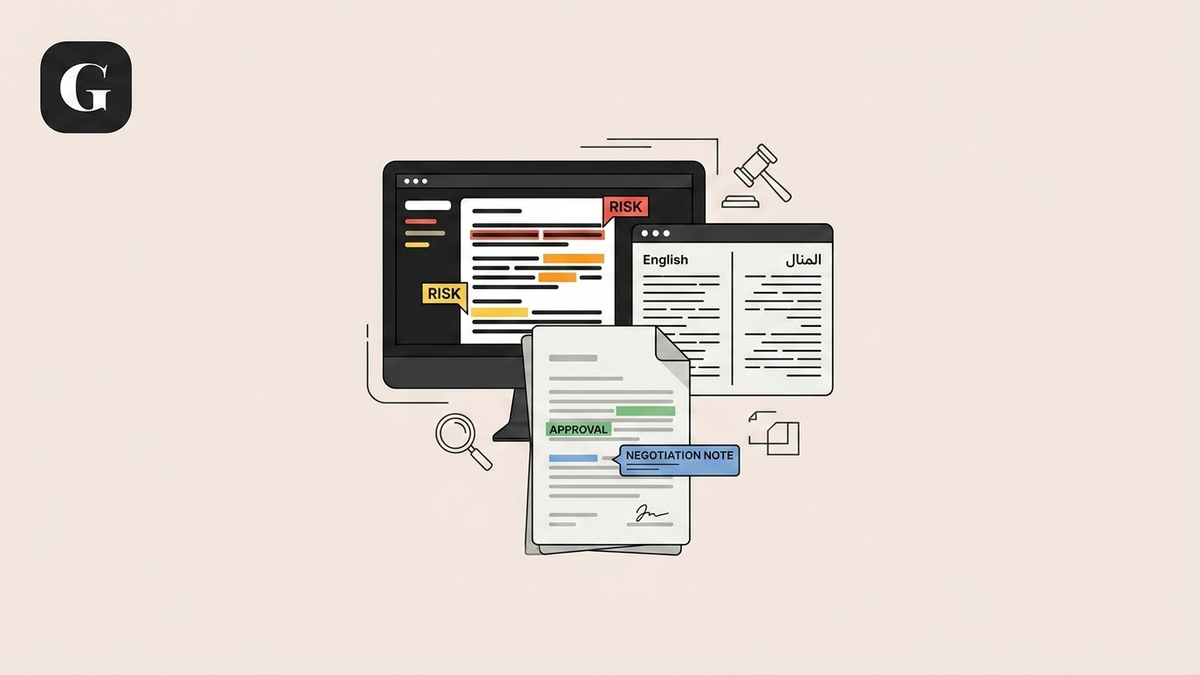
Why AI Legal Document Review Matters for UAE Contracts A contract can look routine until one clause shifts the risk. That matters because Forrester's 2025 analysis found that paralegals using AI for document analysis and summarization cut time by 50%, which is not a small efficiency gain - it is the difference between a document pile and a review workflow that can actually keep up. In the UAE, where tenancy, employment, and sale agreements often mix Arabic and English and carry jurisdiction-specific terms, AI legal document review is useful for one simple reason: it helps people see the clause before the dispute sees them first.
AI legal document review is not a shortcut, it is a triage layer
Good legal review does three things: identifies the document type, spots unusual clauses, and tells you what needs human attention. That is the real value of legal AI tools. They do not replace judgment; they compress the first pass so a tenant, freelancer, or in-house lawyer can focus on the clauses that matter most. This is especially useful in UAE contract work, where one agreement can contain payment terms, renewal mechanics, penalty language, governing law, and Arabic-English wording that does not always line up neatly. A machine cannot decide whether a clause is commercially fair, but it can surface the clause that deserves a lawyer's eye. That is the practical meaning of AI for legal documents: faster sorting, clearer priorities, less manual scanning.
Why clause-level review matters in the UAE
A legal document is rarely risky because of the obvious headline terms. The problem is usually buried in the details: a notice period that is too short, a rent escalation clause that changes how costs rise, a cancellation rule that shifts leverage, or a payment trigger that arrives before deliverables are complete. In UAE tenancy and sale agreements, those details can matter more than the contract title itself. Plain-language translation is the point here. "Clause-level review" means reading each provision on its own, then checking how it interacts with the rest of the document and the governing jurisdiction. If an agreement says one thing in Arabic and another in English, the review question is not academic. It is operational: which version controls, what risk follows, and who carries it. That is why legal document analysis is strongest when it is structured. It should not stop at summarizing a contract. It should break the document into obligations, deadlines, penalties, termination rights, and exceptions. Without that structure, hidden risk stays hidden.
What AI tools actually do well - and where they stop
The best contract review with AI begins with classification. The system identifies whether the file looks like a lease, employment agreement, NDA, or service contract, then pulls out the clauses most likely to affect rights and duties. That is not flashy, but it is valuable. Most people do not need a lecture on contract theory. They need to know whether the contract allows automatic renewal, unilateral variation, or early termination without a penalty cap.
The evidence for this workflow is solid. Deloitte's 2026 research on agreement management found that legal teams reclaimed 37% of their time in agreement and contract workflows when AI-powered systems handled repetitive work. Forrester's 2025 study of large law firms also found a 344% ROI over three years from Lexis+ AI deployment, driven in part by document summarization and analysis. Those are not abstract tech metrics. They show that legal AI tools create value when they remove the slowest part of the review chain. But there is a boundary. AI does not determine enforceability by itself, and it should not be treated as the final legal word on a disputed clause. It is a confidence tool, not a substitute for advice. The better model is simple: use AI to catch the issue, then use legal judgment to decide whether the issue is material.
The three review layers that make AI useful
1. Identification The first layer is document recognition. Before anyone can evaluate a clause, the system has to know what kind of document it is. That matters in the UAE because different contract types trigger different concerns. A tenancy contract raises renewal and escalation issues. An employment contract raises notice, probation, and end-of-service issues. A service contract raises scope, acceptance, and delay exposure. 2. Extraction The second layer is clause extraction. This is where AI legal document review earns its keep. It isolates the actual text governing payment, termination, indemnity, liability caps, and jurisdiction. If the system cannot point to the clause, it has not really reviewed the contract. 3. Risk framing The third layer is risk framing. A useful system does not just say a clause exists. It explains why the clause is unusual, which side it favors, and what follow-up question to ask. That is where a platform like Graysen fits naturally into the workflow, because the useful output is not jargon but a readable explanation tied to the source text.
The mistakes people make when they trust AI too much
The first mistake is assuming speed equals safety. It does not. A fast review can still miss a bad renewal term, a one-sided indemnity, or a clause that only makes sense in one language version. The second mistake is treating AI summaries as if they were the contract itself. Summaries are a map, not the territory. The third mistake is ignoring jurisdiction. A contract review tool that cannot explain UAE-specific context is not doing legal analysis, it is doing generic document summarization. In a market where wording, language, and local law all affect interpretation, that gap is not minor. It is the whole problem. This is why the strongest use case for AI for legal documents is not to eliminate review work, but to make review work more disciplined. It keeps people from reading blindly and forces a better sequence: identify, extract, assess, verify.
How to use AI legal document review without creating new risk
Start with a clear checklist. Ask the tool to identify the contract type, extract the payment, termination, liability, renewal, and governing law clauses, then flag anything that looks asymmetric or incomplete. If the tool cannot show you the exact clause text, treat the output as incomplete. Then use the human step where it counts. If a lease, employment agreement, or SPA touches money, possession, deadlines, or penalties, legal document analysis should end in a source-backed explanation, not a generic summary. That is the standard worth holding. The practical test is easy: if the AI review does not help you answer, "What exactly does this clause do, who does it favor, and what happens if I sign?" then it has not done enough. For anyone handling a UAE contract today, the next move is straightforward: take one active agreement, ask an AI legal document review tool to extract the five clauses that control money, exit, and liability, then compare those outputs against the original text line by line. That one comparison will tell you quickly whether the tool is a real review aid or just a faster way to skim.