How Graysen Makes Legal Document Generation Simple for Non-Lawyers If you are trying to create a lease addendum, service agreement, or NDA in the UAE, the real problem is not typing. It is knowing which clause belongs in the document, which terms cannot be copied from another country, and which details turn a usable form into a risky one. Gartner's 2026 research says 50% of contract reviews will be delegated to self-service systems by 2029, while legal tech budgets are expected to double by 2028. That is not a software trend. It is a sign that legal document generation is moving from specialist teams to ordinary users who still need legal accuracy.
Why legal document generation fails for non-lawyers
Most people do not need a thousand-page template library. They need a way to turn a real-world situation into the right document without guessing at legal structure. That is where simple legal documents become difficult: the moment a user confuses a service agreement with an employment letter, or a tenancy addendum with a renewal notice, the whole document can drift away from the legal purpose it is supposed to serve. The core issue is translation. Users think in plain facts, such as who is paying, what is being delivered, where the property is, or when the work starts. The document has to convert those facts into legal clauses, definitions, obligations, and signatures. A good document builder does not just ask for names and dates. It asks the questions that determine clause structure. Gartner's 2025 article on legal technology reported that 64% of legal and compliance leaders plan to accelerate investment in legal technology. That matters because the market is signaling a shift in how legal work gets done. The more routine drafting moves into self-service tools, the more the tool must protect the user from bad structure, not just make writing faster.
What a good document builder must do
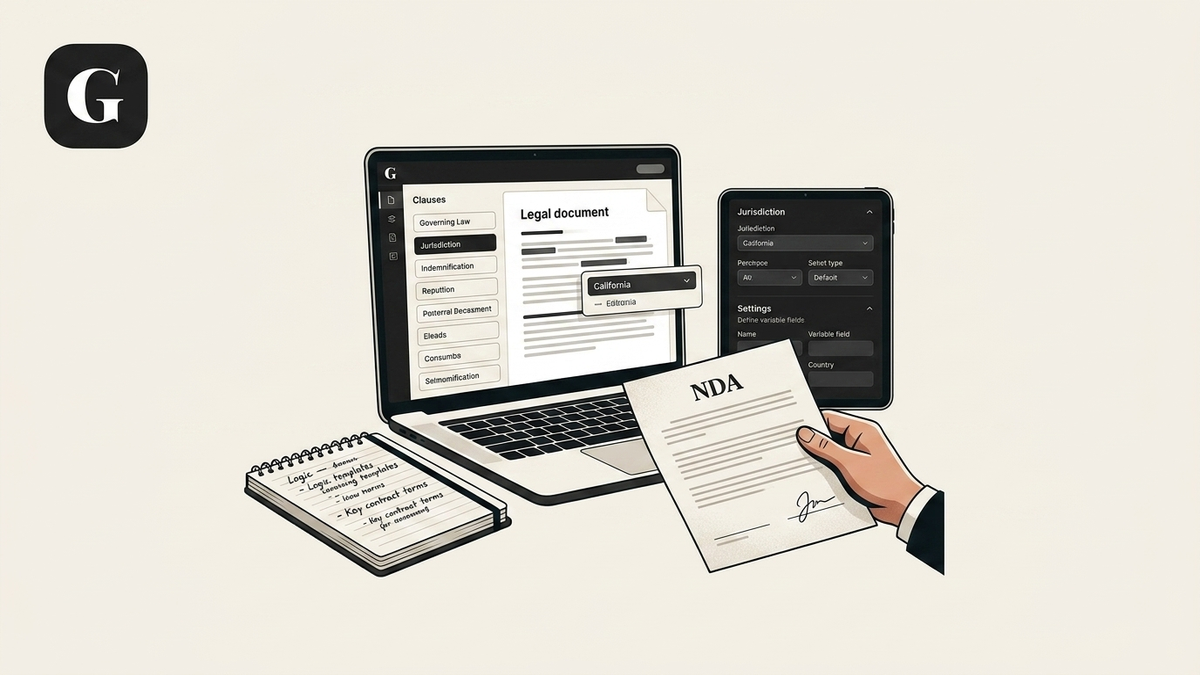
A proper document builder for UAE legal documents should do three things well: identify document type, collect only the facts that matter, and force the right order of clauses. If any of those steps is missing, the user ends up with a polished-looking document that still fails at the legal level. First, document-type recognition prevents category mistakes. A lease is not a service contract. An NDA is not a settlement agreement. The tool should identify the legal purpose early, because purpose determines which sections appear, which obligations are included, and which clauses are irrelevant. Second, the builder should request only the inputs that change the legal meaning. A field for the landlord's name matters. A decorative field for the user's company motto does not. The best systems reduce cognitive load by asking one legal decision at a time, instead of dumping the entire form on the user at once. Third, the output has to follow clause logic. Parties come before obligations. Payment terms come before default terms. Jurisdiction and governing law come before signature mechanics. That sequence is not cosmetic. It is how a reader checks whether the document hangs together.
Why UAE legal documents need jurisdiction awareness
UAE legal documents cannot be treated as generic English-language forms with local names swapped in. The legal meaning of a clause can change depending on whether the document touches tenancy, employment, free zone practice, onshore commercial activity, or a bilingual setting where Arabic and English versions need to align. That is why plain-language legal translation matters. The tool must explain the issue first, then name the term. For example, instead of presenting a user with a wall of formal text about termination, the system should say what the clause does, who can end the agreement, what notice is required, and what happens to unpaid amounts or deposits. Then it can map those facts into the clause. Deloitte's 2025 research found that 78% of enterprises consider intelligent automation a critical driver of digital transformation, and Gartner's 2025 research says 70% of organizations are expected to use intelligent document processing as part of digital transformation by 2026. Those numbers matter here because document workflows are no longer judged only on speed. They are judged on whether the system can handle structured information without losing legal meaning. For UAE use cases, jurisdiction awareness also means not pretending all contracts are interchangeable. A clean draft still needs the right governing law, the right venue logic, and language that does not smuggle in assumptions from another legal system. That is the difference between easy to use legal documents and documents that only look easy.
How Graysen reduces mistakes without pretending to replace counsel
The strongest legal tools do not act like lawyers. They act like disciplined translators. They turn a user's facts into a controlled draft, point out missing information, and flag places where the document may need review before signature. That is the confidence benefit: the user understands why the clause is there, not just that the clause exists. In practice, a platform like Graysen uses a legal document generation flow that is built around structure, not guesswork. It recognizes the document type, supports bilingual Arabic and English processing, and keeps the user inside the logic of UAE legal documents rather than forcing them to draft from scratch. Used correctly, that saves time and lowers error rates without encouraging users to ignore legal review where the stakes are high. This is also where simple legal documents stop being simplistic. Simplicity is not fewer legal concepts. It is fewer decisions at once, fewer places to make a wrong assumption, and clearer explanations when a clause has consequences. A user should never have to decode legal jargon before they can answer a basic question.
A practical checklist for safer drafting Before you generate any document, check these five points: What is the legal purpose of the document? Which jurisdiction governs it? Which clauses are mandatory for this document type? Which facts must be user-supplied because they affect legal meaning? Where could bilingual or cross-border wording create conflict? If the tool cannot help you answer those questions, it is only a formatting layer. If it can, it becomes useful for non-lawyers who need documents that are usable, readable, and less likely to be rejected for obvious drafting errors. That is the real value of a document builder in the UAE market. It is not just faster typing. It is a controlled path from plain facts to structured legal text, with enough jurisdiction awareness to keep the output credible. The next time you need a draft, start by writing down the document's purpose in one sentence, the governing jurisdiction in one line, and the three facts that would most change the clause language. If the platform cannot turn those inputs into a clean first draft, you do not yet have a usable legal workflow.